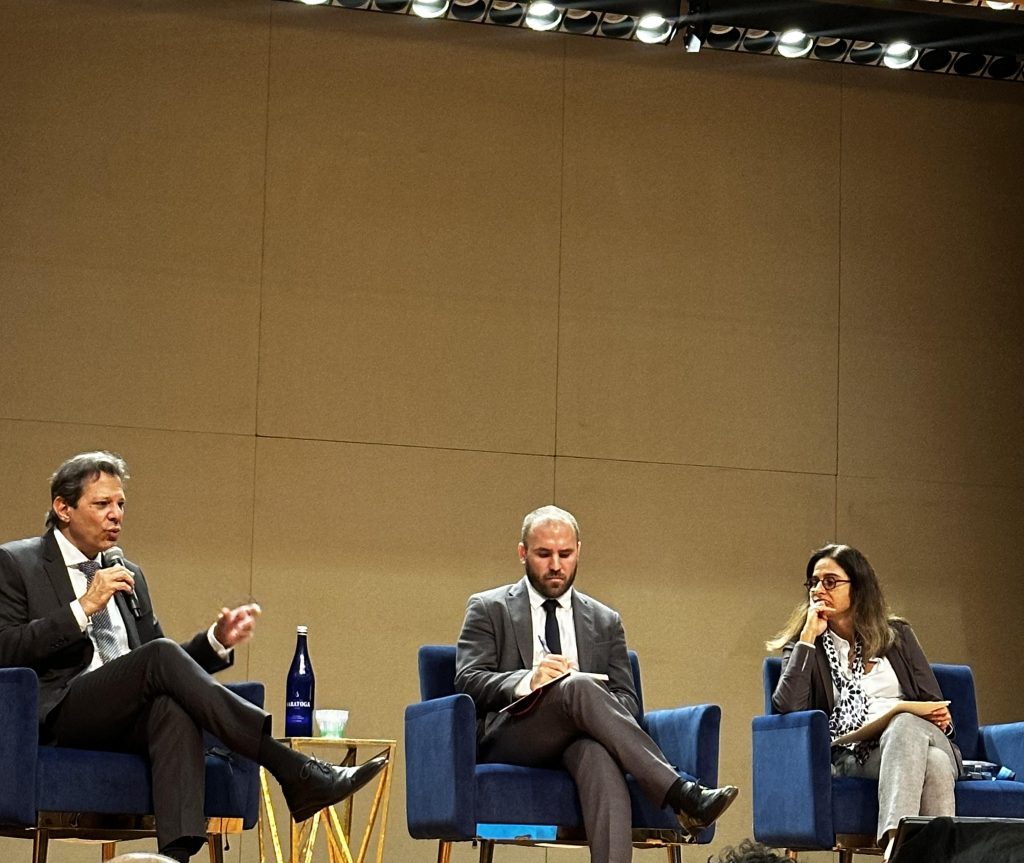


On the eve of the 78th UN General Assembly, I had the chance to attend a compelling event on a subject that has dominated recent headlines: the environment.
Columbia University’s Institute of Latin American Studies (ILAS) hosted “Brazil Leading Climate Justice: A Global Vision for the Future.” The New York gathering brought together three Brazilian cabinet ministers: Marina Silva (Environment and Climate Change), Margareth Menezes (Culture), and Fernando Haddad (Finance).
Marina Silva opened the panel by stressing the urgent need for ecological transformation. In her view, the pursuit of strength, freedom, and the sacred has given way to a pursuit of “having” — a mindset she argues is destroying our planet. Talking and planning are positive steps, she warned, but they don’t guarantee effective policy results. In an age of climate change, complacency is unacceptable and costs lives. Mitigation and adaptation, she said, are not enough; transformation is essential.
Margareth Menezes followed, challenging a narrative that frames Brazil as an inevitable leader in sustainable development. She pointed to the country’s harsh history of slavery and inequality, but recalled that Brazil has always been at the forefront of cultural innovation in music and art. The singer and activist called on everyone to reinterpret that “vanguard” spirit in service of climate justice — one that includes ancestral Indigenous and African traditions. For her, this is essential to advancing the climate cause in a just way.
Fernando Haddad, the Finance Minister, addressed the role of the economy in climate justice. He presented initiatives such as carbon credits, green bonds, and Brazil’s Ecological Transition Plan, highlighting their sustainable potential. Haddad expressed confidence that Brazil can grow faster than the global average while also achieving higher environmental quality than any other country. He underscored the importance of Brazil’s leadership in the G20 for global cooperation and sustainable solutions. He also noted that a trade agreement with the European Union is essential for Mercosur — the South American trade bloc — and could strengthen it, especially amid elections in Argentina, where a far-right candidate stood a strong chance of winning.
This event at Columbia offered valuable insight into how Brazil can lead efforts to confront global climate challenges, weaving cultural and economic traditions into a unified movement for climate justice. The ministers and experts made clear that action is imperative, and that Brazil has a crucial role to play on the international stage.
Major responsibilities await Brazil internationally in the coming months: leadership of the G20, the Mercosur agreement, and the bilateral meetings taking place during the General Assembly. These could strengthen Brazil’s leadership role on the environment and help pave the way for an ecological transition — bringing renewed hope of meeting Brazil’s pledge to cut its carbon emissions by 50% by 2030.
Now we root for the green transformation.
Originally published in Portuguese on felipemoura.xyz, September 19, 2023.